Table of Contents
Introduction
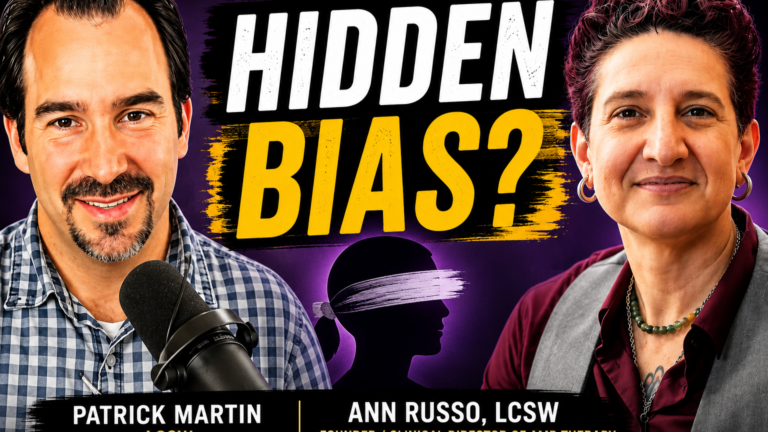
Why do clients leave therapy without saying why? While there are many reasons clients discontinue treatment, one often-overlooked factor is implicit bias in therapy and the unconscious assumptions that can influence the therapeutic relationship.
In this episode of The Mental Health Toolbox, Patrick Martin sits down with Ann Russo, LCSW, MA, Founder and Clinical Director of AMR Therapy, to explore how implicit bias, cultural humility, LGBTQ+ affirming care, and ethical self-reflection influence effective psychotherapy.
Whether you’re an experienced clinician or just beginning your career, this conversation offers practical strategies for becoming a more culturally responsive and effective therapist.
Watch the Episode
Key Takeaways
Every Therapist Has Blind Spots
No therapist enters the profession without personal experiences, assumptions, and unconscious biases. These influences aren’t signs of incompetence—they’re part of being human.
The challenge is remaining curious enough to recognize them before they interfere with the therapeutic alliance.
Ann discusses how therapists can continually examine their own perspectives while creating a safer space for clients from diverse backgrounds.
Practical Tips for Therapists
After listening to this episode, consider asking yourself:
- Have I examined my own implicit biases recently?
- Am I seeking enough supervision and consultation?
- Do I know when a referral is ethically appropriate?
- How can I continue improving my cultural competence?
Cultural Competence Is a Lifelong Process
Rather than viewing cultural competence as a destination, Ann encourages clinicians to approach it as an ongoing commitment.
Professional growth includes:
- Continuing education
- Consultation
- Supervision
- Listening to lived experiences
- Remaining open to feedback
The most effective therapists continue learning throughout their careers.
Understanding Does Not Require Agreement
One of the most thought-provoking moments of the conversation centers on Ann’s experience attending a religious conversion conference.
Instead of reinforcing stereotypes, the experience helped her better understand the fears, beliefs, and motivations of people whose perspectives differed significantly from her own.
That understanding ultimately strengthened her work with families navigating religious and identity-related conflicts.
Empathy often begins with curiosity.
Ethical Practice Includes Knowing Your Limits
Therapists are not expected to be experts in every area.
An important part of ethical practice is recognizing when additional training, consultation, or referral will better serve a client.
Rather than viewing referrals as failures, Ann frames them as an important expression of professional responsibility.
Why Clients Leave Therapy Without Saying Why
- Therapeutic alliance
- Hidden bias
- Cultural humility
- Scope of competence
About Ann Russo
Ann Russo, LCSW, MA in Theology, is the Founder and Clinical Director of AMR Therapy.
She specializes in:
- LGBTQ+ affirming therapy
- Cultural competence
- Ethical non-monogamy
- Religion and mental health
- Clinical consultation
- Continuing education for therapists
Learn more at:
Frequently Asked Questions
What is implicit bias in therapy?
Implicit bias refers to unconscious attitudes or assumptions that can influence clinical judgment and interactions with clients. Developing awareness of these biases is an ongoing part of ethical practice.
Why is cultural competence important for therapists?
Cultural competence helps therapists understand how identity, lived experience, and social context influence mental health, allowing them to provide more responsive and effective care.
What is LGBTQ+ affirming therapy?
LGBTQ+ affirming therapy recognizes and supports diverse sexual orientations and gender identities while creating a safe, respectful, and inclusive therapeutic environment.
Resources Mentioned
Ann Russo
Website:
https://www.annrusso.org
Professional Training & CEUs:
https://www.annrusso.org/courses/
Newsletter:
https://dashboard.mailerlite.com/forms/981712/124700102617990202/share
Mental Health Toolbox
🔑 All Access Pass
Access every worksheet, therapy handout, and clinical resource in one membership.
Watch The Interview
If you liked this episode, be sure to check out my full playlist of interviews here: https://youtube.com/playlist?list=PLnPL9gahfhWatKmy2YSyU0jt20h_jrj3H
Listen To The Interview
Continue Learning
If you enjoyed this conversation, explore more interviews, therapy tools, and clinical resources at The Mental Health Toolbox.
Or unlock instant access to our complete library of worksheets, courses, and therapy handouts with the All Access Pass.
👉 https://thementalhealthtoolbox.com/allaccess
WORKBOOKS | JOURNALS | E-BOOKS | THERAPY HANDOUTS | GUIDED MEDITATIONS
Discover our wide range of meticulously crafted and thoughtfully designed workbooks, journals, e-books, and therapy handouts, tailored to empower your therapy practice or personal growth journey. Our diverse collection of resources caters to individuals seeking self-improvement, mental health professionals, and those yearning for deeper self-awareness. Each product is enriched with valuable insights, practical tools, and actionable strategies to help you unlock your full potential, overcome challenges, and achieve lasting change. Explore our SHOP page to find the perfect companion for your transformative journey, and experience the benefits of investing in your well-being today.
*Some of the links found here are affiliate links: As an Associate I earn from qualifying purchases by way of commission at no additional cost to you. See full disclaimer here:
This Episode Is Brought To You By:

Stream live to YouTube and all of your socials at once; Record your videos and podcasts; edit and post shorts and clips.
This tool is a Game-Changer for any content creator 🙌

TherapyNotes® is a complete practice management system with everything you need to manage patient records, schedule appointments, meet with patients remotely, create rich documentation, and bill insurance, right at your fingertips. Our streamlined software is accessible wherever and whenever you need it.
This tool is a MUST for any practice owner!


Read the Interview Transcript
Episode Transcript: Culturally Competent Therapy & LGBTQ Inclusivity
Read the full interview with Ann Russo, LCSW, founder of AMR Therapy, as she discusses breaking down implicit biases, navigating religious trauma, and building an inclusive private practice.
1. Introduction: Meeting Ann Russo, LCSW & AMR Therapy
Patrick Martin, LCSW: As therapists, we know that it’s imperative to be culturally competent in the clients we serve, especially the marginalized populations. And it’s imperative that we understand the steps that we can take to ensure inclusivity and empowerment, especially with those at risk and those coming from different diverse backgrounds, such as the LGBTQ population. So to help us navigate these waters, we have our special guest, Anne Russo, who is the founder of AMR Therapy and is a licensed psychotherapist with a master’s in theology, concentrating on liberation theology.
Anne specializes in queerness, sex, relationship diversity, and the intersections of religion and mental health. Anne was raised in a queer household, living with two of her fathers, her mother, and sister under one roof. Her early exposure to diverse family dynamics has profoundly shaped her approach to mental health, fostering an inclusive and empathetic environment for her clients. And she’s going to help give us some tips and tricks, how we can manage our implicit bias, our blind spots around inclusivity, and make sure that we’re doing our very best to help the clients we serve. So without further ado, let’s meet Anne. Hey, Anne, welcome to the show.
Ann Russo, LCSW: Hey, Patrick. Hi, thank you. I’m so excited to be here today. Thank you for having me on.
Patrick Martin, LCSW: Oh, very excited to have you on. Thank you for being here. As professionals, we know that none of us are above implicit bias. None of us have it all figured out. We all make blunders and have the ability to offend our client. And a lot of times clients won’t even tell us when we’ve missed the boat, right? Because there’s that sometimes power differential, sometimes it’s cultural. And we know that clients will oftentimes just drop out of treatment without saying something, if we’ve somehow made a blunder, right? And we’re maybe not even aware. So I’m very excited to have you on to talk about this very important area of inclusivity and how we can navigate these waters as providers. So thank you for that.
Ann Russo, LCSW: Oh, my pleasure. You know, Patrick, just hearing you start, I’m like, which direction? There’s so many elements to this. I’m really excited to talk about it today.
Patrick Martin, LCSW: And of course, you’re a group practice owner. You started a telehealth practice before the pandemic hit when telehealth was taboo, you know. Yes, I was right there with you. I’d started my telehealth stuff before the pandemic hit and it was kind of like very fringe at the time. There weren’t many resources for doing telehealth and now it’s obviously the doors got burst open on that with the pandemic. And I guess that’s one silver lining is access to care, right? And specialized care.
Ann Russo, LCSW: Absolutely. Yeah, absolutely. Absolutely.
Patrick Martin, LCSW: And I do believe in tools up front here. So I’m just going to share a little bit about where people can find you in case they want to take some footnotes here, everybody. Anne has both a private group practice you can check out. That would be the AMR therapy side at amrtherapy.com. You can see the wonderful work she’s doing here, as well as her team of therapists under her, and she has a wonderful blog as well. You can find all that here at the bottom of her website.
In addition to this, she’s doing wonderful work around equipping other therapists to be more aware and inclusive and working on some CEU stuff and some courses and a book. We’ll talk more about that. So if you want to learn more about the work she’s doing there and to make sure you’re kept abreast, sign up to her mailing list, you can go to AnneRusso.org. All right, those are the tools up front. Let’s get into it. I do that because I know that most—maybe I’m odd—I tend to, I don’t like open loops and I like to finish what I started in terms of listening to podcasts and audio books. But I know a lot of people, they get busy and they might start at the gym, but then they drop off and they don’t get to the end. So I figured why would we kill the end?
Ann Russo, LCSW: Totally one of those people. So I get it. So I appreciate that up front. Yes. For sure, for sure.
2. Liberation Theology & Overcoming Family Stigma
Patrick Martin, LCSW: Well, Anne, we know a little bit about your background, but what led you into being a champion in this space? What’s your story?
Ann Russo, LCSW: It really was the upbringing, Patrick. Yeah. Being raised in a non-traditional household and understanding the challenges that people face that aren’t part of what society deems normal, especially, you know, in the 80s and 90s, it was a bit different than now. And I always knew that I wanted to do work in some form of social justice. So, as a world knowledgeable first grader, I thought, I’m going to be the president of the United States. That’s where I’m going to make that change. So why not, right? So that was like the goal. I thought it was going to be through politics all the way up until I graduated from high school.
And when I went into college, I realized that’s not actually my calling at all. The calling is to help individual people that then can impact systems and education and research. And so I just kind of fell into it naturally. I was always someone who wanted to help my friends. And when I saw injustice, I started the first queer club at my high school. I was always just doing something, always, always. And I saw a lot of trauma around religion, Christianity, especially when it came to queer identity. So my first move was to get my master’s in theology, which is a focus on liberation theology, which is the idea of using Christ as someone who liberates the marginalized community. And then from there, I went on and I got my master’s in social work. So I really do use the combo of the two for my specialty to really understand and help people struggling with religion, specifically Christianity and community.
Patrick Martin, LCSW: That’s fantastic. Wow, what a great foothold to make a difference in this field. It’s interesting that it was a master’s in theology first and then the MSW. Oftentimes you see it in the reverse order, right?
Ann Russo, LCSW: Yeah, you know, I thought I would be teaching, like I wanted to teach and help people in that way. I guess I just didn’t really—it hit me like, wait a minute, I can do therapy. This will be great. I can really touch these people in a different way and really help the people that are impacted. So it made sense. And here I am.
Patrick Martin, LCSW: Yeah, that’s fantastic. So how long have you been at this work and kind of what has been your moving target, so to speak?
Ann Russo, LCSW: So I’ve been—I feel like I’ve been doing this work since I came out of the womb on some level, but if we’re going to talk about the specific religiosity piece, when I was 18 or so, I got involved with a Christian church and just wanted to learn a little bit about what was going on there, because growing up on the other side, it was “Christians are against us, against our family”. So it was like, well, who are these people that are against us? Because they seem to be everywhere. So I really got involved. And I started to understand what their perspectives were, what they were thinking. And I really wanted to fully embrace this very different experience from what I grew up with. So that way I feel like I could start to make some changes with personal relationships. I think it really does come down to those personal relationships. So that’s what I did. I spent a lot of time with people that believe they never even met a gay person before. We talked about what that meant. Oh, a gay person can like God? Yes, they can. You know, and we’re just learning from each other. So that was just a deep lifeline for me. And it was just so fulfilling. I couldn’t imagine really doing anything else. So I just went to school for what felt like 100 years to get myself to this place.
Patrick Martin, LCSW: I’m sure, I’m sure. So were you raised in a particularly religious household or was it more or less agnostic?
Ann Russo, LCSW: I wasn’t. I was actually raised—my family traditionally, you know, Italian Catholic, but my immediate family with my dad coming out, it was, religion really became the enemy. Christianity really became the enemy. So I was not raised in any kind of religious household at all.
Patrick Martin, LCSW: Because of the stigma.
Ann Russo, LCSW: Yeah, the stigma. Yeah. So, and I would see on TV, back in the day of the Oprahs and the Donahues and the Geraldos, they would have a lot of religious right people coming on and just speaking terribly about, you know, gay people and how they’re going to hell. And, you know, you see a lot of this growing up and people holding the signs on the streets, and as a kid, that can be really confusing as to why people feel this way.
Patrick Martin, LCSW: Yeah, especially towards your parent. Who you love. And then why are they—why is it, you know, why is everyone doing this? Why is everyone treating my dad this way? That could be very confusing for a child. How did you navigate that?
Ann Russo, LCSW: As a very young child, we were quiet about it. We didn’t share about the family. We feel like we moonlighted as a traditional family because my mom was living with us as well at this time. And so my dad had his partner living in the house with us, but we called him a roommate. I’m sure people knew something was off, right? But that’s just the way that we lived. And it wasn’t until high school when we moved from Arizona to California that we were allowed to start sharing about the reality of dad’s relationship.
Patrick Martin, LCSW: Because California is more liberal.
Ann Russo, LCSW: Is more liberal, yes. Yeah, it was more liberal. But I have to tell you, even with the ability to do that, it was still very scary because, you know, you spend 10 years of your life that this is the family secret. People don’t like people like this. You’re not exactly going to run out and start sharing. So it was—I would say the first year or so it was difficult. I was also, you know, coming to terms with my own sexuality as I, you know, I am a queer person as well. And so all of that combined was like a whirlwind. But I guess what really shifted for me was, am I going to sit here and just allow this to happen? Or am I going to stand up? Because I know I’m not the only person. Something within me just said, “Anne, stand the heck up, do this. Champion this”. And it was truly a calling for me to do that.
Patrick Martin, LCSW: Were you ever targeted at school or elsewhere because of your family dynamics?
Ann Russo, LCSW: In high school, when I tried to start the first gay club, I was actually called into the principal’s office and told we could not start the club because it was a club that was trying to give some kind of message. But I remember saying to the principal, “Well, you have a Christian club on campus. Is that not the same thing?” And I had a couple of teachers really championing us as well. So we—with a very minimal threat of contacting the media—they did give us our club. And then we were able to march in the Pride parade the following year. Which is so cool, Patrick, because I came back to Long Beach, California, where this all took place. And I went to the pride parade here, and there was the school board marching in the parade. And on that float was a friend of mine from high school that marched with us in the original first pride parade. It was so cool.
Patrick Martin, LCSW: How was that for validation?
Ann Russo, LCSW: Amazing, amazing. You know, it’s just—it’s great to see the strides that are taking place in understanding communities. So love it. Very happy.
3. Addressing Implicit Bias & Religious Conflicts
Patrick Martin, LCSW: Great work you’re doing. Great work to raise awareness, right? To seek understanding. We know that prejudice comes from lack of understanding. Prejudice comes from fear of things that are different than the status quo, right? What are some of the missteps, do you think, or the myths around the religious conflict dynamic intersection, as you put it? What do you think are some of the things that fuel the stigma, if that makes sense?
Ann Russo, LCSW: Yeah, it does. So I’m going to stay away from arguing about interpretation, because I think we can get kind of messy in that. I’d be more than happy to do that in a CEU class for anyone who’s interested, but for all purposes, I do think there’s a fear. I think there’s a misunderstanding. And I find that a lot of leaders of churches will demonize LGBTQ people as though they are only interested in sex, drugs, rock’n’roll. They can’t possibly have a relationship with God. So when you have parents, especially hearing these kinds of messages and their child comes out, they think, oh my gosh, I’ve seen the statistics. My child is going to go be homeless on the street and they’re going to get HIV and they’re going to turn away from God and go to hell.
So it’s the lack of understanding that being a gay person is simply being a person who is attracted to the same sex. It has nothing to do with how you necessarily live your life, what your values are, right? But I think that that’s just been bred into the minds of conservative Christian believers so much that it scares them. And then we do have, you know, there are obviously members of the gay community, like there are members of any community, that maybe are a little bit more sexually exploitive or they’re using drugs or they’re doing things, but it’s really hyper-focused on the gay community rather than seeing the community as individual members that are in an umbrella, right?
Patrick Martin, LCSW: That makes total sense. I mean, if we only have one picture painted, that’s where our mind goes, right? It becomes cause and effect. Yeah. So rather than focusing on more vertical, we’re looking at the whole person, right? And that it’s not a one-size-fits-all kind of dynamic with anything, right? I mean, you could apply that to not just these marginalized communities. It could be anybody. Like if you look at—you brought up homeless—you look at somebody who’s homeless, and a lot of people are conditioned to think that automatically means they’re a drug addict, or they don’t want to be homeless, right? But as therapists, we know that there are homeless families living out of their car because most Americans are one paycheck away from losing their house, and then it doesn’t take much. It only takes a couple bad circumstances to turn somebody’s world upside down.
And it’s not easy, especially in places like California, to find housing. But those are not the things we typically think about when we see somebody homeless on the street. We don’t ask ourselves, “I wonder how long that person’s been there” or “Are they okay with being homeless?” or “I wonder what their struggles are,” right? It’s because, like you said, conditioning. It’s a lot of what we’re conditioned to. That goes back to that idea of implicit bias. We may not even mean it from a place of prejudice. It’s just programming, right?
Ann Russo, LCSW: Absolutely. And that was the biggest lesson for me at a fairly young age, which I’m really grateful for, was by immersing myself in a more conservative Christian denomination, really understanding their viewpoints. I even went—my friends will laugh at me for this—but I actually went to something called Exodus International. It has since been debunked, but it was basically like a “turn the gay away” kind of conference where you go as a gay Christian and they’d help you no longer be gay. It’s not the same as conversion therapy. Just, it’s harmful, of course, right? But it’s not the same. And you know, I went to this all-day conference and I’m listening to these people talk and these ex-gays talk and I’m realizing this is not hate. This is not coming from a place of hate. Now, I can’t obviously say that—I can’t speak broadly for everybody, right? But what I saw was like true fear and concern about these people’s souls.
“How can we love you and help you no longer give in to this temptation of sin because we want you to be in heaven with us?” And that completely changed the way that I think. And it also helps me so much in my practice, because if I work with parents who feel this way, I can come from a very compassionate and empathetic space, rather than like, “you better get on board with your gay kid,” because that’s not going to help anything. So I feel like I have that unique juxtaposition of like, okay, what’s everyone kind of feeling here? And how can we really start moving forward together?
Patrick Martin, LCSW: Right, because understanding is the only way through, right? The healing. And if we don’t have our understanding, then we gravitate toward blame, right? Other than anything, you know, things get lost in translation. What somebody may look like they’re trying to exclude, but in their own way, they’re maybe trying to include, but from their own lens.
Ann Russo, LCSW: Yep. And by no means do I feel like this is an easy thing. I mean, I can recall a few times where I did presentations to talk about like being queer and Christian. I would have, you know, people file in with their Bibles, wanting to argue with me, and then I’d have people come in that were ready to argue with the people that filed in with their Bibles. You know what I mean? This is just such a contentious situation and it’s—there’s just so much pain. You know, and I know that there are many queer folks, LGBTQ folks who are just over it. They’re hurting, they’re pissed, they don’t even want to engage. I get it. We’re tired. I’ll engage for you.
4. Cultural Competency Tips & Building an Ethical Private Practice
Patrick Martin, LCSW: Absolutely. Yeah. Which begs the question, as therapists, how can we—how can I be careful to make sure I’m being inclusive, to make sure I’m not missing anything in the way I work with, be it a client, be it a family, be it their parents, teenagers who might be questioning? What are the potholes I should be watching out for, do you think? And what levers can we pull to make sure that we’re not missing the important things because we’re distracted with the minutia of it?
Ann Russo, LCSW: Know the community. Like, honestly, you know, I think that sometimes we can say—and I want to make this caveat, because there is not enough of us out there, right? Like we’re trying so hard to work with everybody. And I think that in school, we’re kind of taught, you can work with anybody. My personal philosophy is, no, we can’t work with everybody. You know, it’s just different life experiences and identities. They matter. They really do. And there are those nuances that we just are not going to understand unless they’re part of that community, or at least involved in that community in some way. So I would go to places where there are the populations that you’re interested in working with that you may not be a part of, as long as you’re welcome in that space, go. Have diverse friends, read books, take classes, have really good resources.
Other therapists that can do the work that you may not be able to do. Don’t be afraid to do that. There are some things people come in—you know, they’re working, they have an eating disorder or substance abuse. Could I help? I could, but that’s not my niche. So I make sure that I know people that can do that, you know what I mean? So I really think it’s, you have to have that level of self-awareness. How much do I really understand this community?
Patrick Martin, LCSW: What’s the ethical thing to do?
Ann Russo, LCSW: What is the ethical thing to do? And why are they here, right? Like, if a queer person comes in and says, “I’m having a hard time with my job,” and it has nothing to do with their identity, well, that’s different than if they came in and said, “I’m having a hard time with my job because I’m being gay bashed at work”. So it’s like we kind of have to really suss through in our assessment process if we are the appropriate providers for people.
Patrick Martin, LCSW: Kind of the old adage, you know, we have to walk a mile in their shoes, but how do we do that to the best of our ability? Like you said, we can get close to the communities, we can orient to understand maybe at a deeper level what that experience is like and maybe be a holding space for those people until we are in such a position that we can link them to a more appropriate, beneficial source, right?
Ann Russo, LCSW: Yes. You know, Patrick, I think too, like when we start off getting our hours, at least this was for me, it’s like, go, and everyone’s your population, and you’re like, oh my gosh, and you’re trying to figure this out. And I think that what gets missed in all of that intense work that we’re learning how to do is: Who do I really want to work with? Why do I want to work with them? And kind of honing in on the population that really is a good fit for you and not being afraid that you’re going to run out of clients. Because I think that could be another piece of it, right? Like if I just specialize in this, I’m going to miss all this. I find the opposite is true.
Patrick Martin, LCSW: I’m so glad you brought that up. And I was hoping maybe you could talk a more about this particular vertical, right, is because therapists oftentimes start in the county or community outpatient mental health setting, get their hours, and sometimes they stay there, but sometimes they do branch out into private practice. But there’s a very—sometimes seemingly large chasm, and there’s a lot of fear between whether, like you said, they’ll come up dry, or if there’s enough people to work with. And what would be your advice for that? Being a group practice owner, now having a thriving practice of your own that sounds like it’s pretty well self-maintained. And of course, you were in the Wild West of virtual therapy. Talking about being the tip of the spear, what was that like for you? How did you navigate those fears and how would you advise therapists looking to make that leap if they’re feeling scared of the risk involved?
Ann Russo, LCSW: I would say you’re on the right track. It is scary. It’s very scary. I was very nervous about whether or not I could do this. So how I went about it was like I continued with a part-time job with another agency and I just slowly started to build up this practice. And I did it through—I mean, there’s a lot of business stuff. I’d be more than happy to talk to anybody who wants to understand the business side of it. But I knew the populations that I really wanted to work with. So I—and I wanted it to be affordable and accessible. And I thought, if I have a brick and mortar, I’m going to have to pay for this brick and mortar. Well, that cost is going to get passed down to my clients. That’s not cool. I don’t want to do that to them. And then I also didn’t want to take insurance because I personally don’t like what we have to do with insurance companies in order to get care. So I’m like, how can I make this work, right?
Patrick Martin, LCSW: So, to dance in a circle and click your heels three times, you know? When I say jump, say how high?
Ann Russo, LCSW: Yeah, right. I mean, come on, let’s do this. I got this. Honestly, you know, and just having to cut off, it just—that just did not work. So I was able to start with—because we are a sliding scale, we’re definitely not in this to make a bunch of money. But we do really work with client incomes. And we will not turn people away once they’re an established client if something happens to their income. We will work with them. The goal is to really help the clients feel better and reach their goals. You know, and we have a really high success rate, so I’m very, very pleased with that.
But I think the main part was finding other people that felt just as passionate about it because when I started out, I was able to recruit some people from grad schools, like, “Hey, you want some extra clients on the side?” And I was really lucky because my intern supervisor from when I was in grad school, who taught me so much, she’s actually the clinical supervisor for the interns for the practice. So I just love the people that are here, all of us working together. And now we do have interns and they have full time. We’re able to give them insurance, 401ks. Like, it’s a big deal. Yeah, I mean, I feel really proud, you know, I feel really, really happy. And they have the flexibility of their schedules. And we really work on advertising to specific marginalized populations. And I want to make sure that our therapists represent those populations as well, you know, that’s very, very important. What are you passionate about? Why are you passionate about this population? And we really do our best to…
Patrick Martin, LCSW: We have a vetting process for the clinicians to hire, there’s certain filters, right, to make sure that they are passionate about the work they’re doing.
Ann Russo, LCSW: Yeah. We are a small practice. Even though we have almost 400 active clients, I still consider us a small practice because I’m very attuned to what’s going on. The clinical supervisor is very attuned to what’s going on. And the therapists are all—we’re all very connected, even though it’s remote. We have groups of revisions together. Everyone—like, we’re—I do, we all do our best to still make this a place that’s very ethical, following all the guidelines and really making sure that we’re doing our best for our clients. So I’m really proud of us. And we get a lot of referrals from other clients. That’s what I would say would be a large piece of our word of mouth. So I feel very proud. I feel very, very proud. This team is amazing and I’m just so blessed to be a part of it.
5. Mission Statements & Ann’s Upcoming Book & CEU Courses
Patrick Martin, LCSW: Yeah, that’s wonderful. And I think that’s probably one of the carrots to private practice is that then you can serve the population you’re most passionate about, the causes that you’re most passionate about, right? And you can kind of create that by your design. And if you’re not careful, though, you can recreate agency work for yourself, right, if you don’t have that clarity, I imagine.
Ann Russo, LCSW: Yeah, no, that’s—yeah, and that’s the thing. It’s like we have a very specific mission statement, and I’m always coming back to that mission statement because it can be easy to deviate, I think, just being a human being. So when decisions have to be made, I say, “Okay, does this actually align with what the intent of this is?”
Patrick Martin, LCSW: That’s so powerful. Very powerful. And I’ve heard it said many times when I’m studying business, successful businesses—and I love small business, and I just finished a book by Patrick Bet David, Your Next Five Moves, and books like that, and Procrastinate on Purpose and all that good stuff like EntreLeadership—I hear that all the time, the mission statement is your guiding compass. How often do we really sit down and think about our mission statement or our values, right? And it doesn’t have to be complicated, right? It’s more about why we’re doing what we’re doing and who we’re serving and how we’re serving them.
Ann Russo, LCSW: Yep. Like you said, you know, it just keeps us aligned. That’s the North Star. We’re always going towards that North Star, right?
Patrick Martin, LCSW: Helps us know what to say no to and what to say yes to.
Ann Russo, LCSW: Yes, absolutely. Absolutely.
Patrick Martin, LCSW: Thank you for sharing that. That’s an easy one to drive by if we’re not paying attention, you know, let our value system be the filter.
Ann Russo, LCSW: Yeah. And even moving a little bit away from AMR, there were some other things that I wanted to do, but I’ve taken that kind of away from AMR and I’m viewing it as like a separate arm so I can ensure that AMR stays exactly how it’s supposed to be.
Patrick Martin, LCSW: That’s smart.
Ann Russo, LCSW: Yeah, which is the affordable, accessible care for clients, right? And then over here, I’m doing some other things for providers.
Patrick Martin, LCSW: Very smart. Yeah, it’s easy, I hear, as businesses get bigger, the challenge is to not water them down as you’re adding more to it, it gets heavier, right? And then things get lost. And sometimes that touch point with the people you serve is not as authentic as you’d like it to be. And we see this with big companies all the time. And the ones that succeed are the ones that somehow, no matter how big they get, they manage to stay small in the consumer’s experience.
Ann Russo, LCSW: Exactly. And it comes down to also what’s going on with the employees and contractors. Like, I touch base with them all the time. I ask them if they like the structure of things, would they do anything different? And I really listen to what they have to say. I’ve made pretty large changes based on feedback. And I think that’s perfectly fine. I want them to be—this is hard work. And I want them to be doing it in a place where they’re happy and comfortable and feel like they can say and do things. Which has been so great because I’ve had some folks that were doing two jobs and they always come here to start doing the full-time work here. So it makes me feel really happy to have that experience. And I’m trying to show them what it means to be in private practice if they ever want to go out on their own too.
Patrick Martin, LCSW: That’s great. So it’s so wonderful that it’s a place to nurture, right? People can serve and be of service and also feel supported, you know, when they’re ready to spread their own wings, if they want to.
Ann Russo, LCSW: They’re a great team, I’m telling you. I just love them all. They’re fabulous people.
Patrick Martin, LCSW: Wonderful. Well, you’re doing wonderful work, no doubt. And definitely, it’s great that you’re making it a priority to work on your business, not just in your business, so that you can serve more people in a way that’s meaningful. That’s no small thing, I know.
Ann Russo, LCSW: Thank you, thank you, thank you. Yeah.
Patrick Martin, LCSW: So you’re working on some CEU courses specifically to inclusion, right, for practitioners?
Ann Russo, LCSW: Yes. We’re just waiting for the ASWB to approve because I want to be able to reach as many people in many states as possible so they can get the credits. So they’ll be launching on the AnneRusso.org website. And we’re going to have a little program in place and people can reach out and do consulting with me about the courses. They’re at your own pace, but I’m here to consult, talk to the practitioners, and I’m looking at maybe doing group consulting if there’s enough interest. I just want to make myself of service for the providers of clients that maybe they’re still kind of learning and figuring out.
Patrick Martin, LCSW: Yeah, that’s wonderful, wonderful work you’re doing. I’ll have to pick your brain sometime. I’ll have you back on the show to talk about the business side of things and how one even gets their course certified as a CEU. You know, that’s—I’m sure it’s its own topic.
Ann Russo, LCSW: My goodness. I turned all gray. This is all dyed now. Yeah, this was a gray move. The bags and the gray, that’s from that.
Patrick Martin, LCSW: Yes, I’m sure. I’m sure, right. In a competitive space, no doubt. So props to you.
Ann Russo, LCSW: Thank you, thank you. And I’m writing a book right now as well, because you know, I figure why sleep, like you were talking about earlier, right? Who needs that? So it’s about female sexuality empowerment and it’s geared towards women in general, but also geared towards therapists working with females that are trying to empower themselves sexually.
Patrick Martin, LCSW: That’ll roll out approximately when? Do we have a date?
Ann Russo, LCSW: I would say it’ll be within the next year because it’s pretty—it’s pretty dense. I’m trying to undensify it. So it’s got religious pieces, it’s got social pieces, exercises, CBT, psychodynamic—just different, it’s a lot going on in there.
Patrick Martin, LCSW: So to cut it down until it hurts, right?
Ann Russo, LCSW: Yes, exactly. Now it’s five volumes, so there you go. The Harry Potter of Female Sexuality.
Patrick Martin, LCSW: There you go. Hey, that’s not a bad title. Trademark. I guess by Harry Potter Incorporated, yeah, exactly. Good stuff. All right. Well, thank you so much. Again, the wonderful work you’re doing. I’ll make sure I tie up all of your links, socials, into the show notes, on the blog, podcast notes, YouTube description, so on and so forth. Love to find out how things are going for you with your book launch down the road. And so feel free to tap my shoulder when things are rolling out and I’ll have you back on. We can talk about it.
Ann Russo, LCSW: I will. Thank you so much, Patrick. I hope you have a wonderful rest of your day and week.
Patrick Martin, LCSW: My pleasure. You as well, Anne. Thanks for sharing. Appreciate it.
Ann Russo, LCSW: Bye-bye.
⭐ Tools I Use to Run My Therapy Practice
As you grow your business, having the right systems in place is half the battle. Here is the exact “Tech Stack” I use to run my practice:
-
TherapyNotes: The EHR I use for notes and billing.
Check it out here -
TWOFOLD AI Assisted Progress Notes: The HIPAA-compliant tool I use for FAST documentation, including custom templates.
Check out your free trial here -
ThriveCart: How I host my courses and sell products.
Check it out here -
StreamYard: The easiest tool for recording video and live streaming.
Check it out here: 14-day free trial! -
My Reading List: Curated books for therapists and clients by topic.
Browse the list -
The Essential Toolkit: My LCSW-approved list of office gear and therapy essentials.
Shop the toolkit
*Some of the links are affiliate links: As an Associate I earn from qualifying purchases by way of commission at no additional cost to you
Want to learn more? Check out my top picks for books on self-improvement and recovery HERE!




The Mental Health Toolbox: Resources and Support for Therapists Seeking Growth & Impact.
Mission Statement: To equip therapists with the tools, knowledge, and strategies they need to enhance their practice, boost their income, and ultimately, improve the lives of their clients. We achieve this through accessible, high-quality content, practical resources, and a supportive community.
NEED CRISIS HELP? If you need immediate crisis help with your depression, you can call the National Suicide Prevention Lifeline at 988 or text “START” to 741-741
OUTSIDE THE UNITED STATES: See International Suicide Hotlines
WHERE TO FIND MENTAL HEALTH HELP:
-NAMI Referral Helpline: 1-800-950-6264
-California’s Statewide Mental Health Helpline: 1-855-845-7415